
For most small businesses, the website is the storefront, sales team, and brand ambassador all in one. The problem is that many teams treat design and marketing as separate projects. In 2026, the wins come when you plan and execute them together. When your site is built for speed, search, and conversion from day one, every click works harder, acquisition costs go down, and growth compounds.
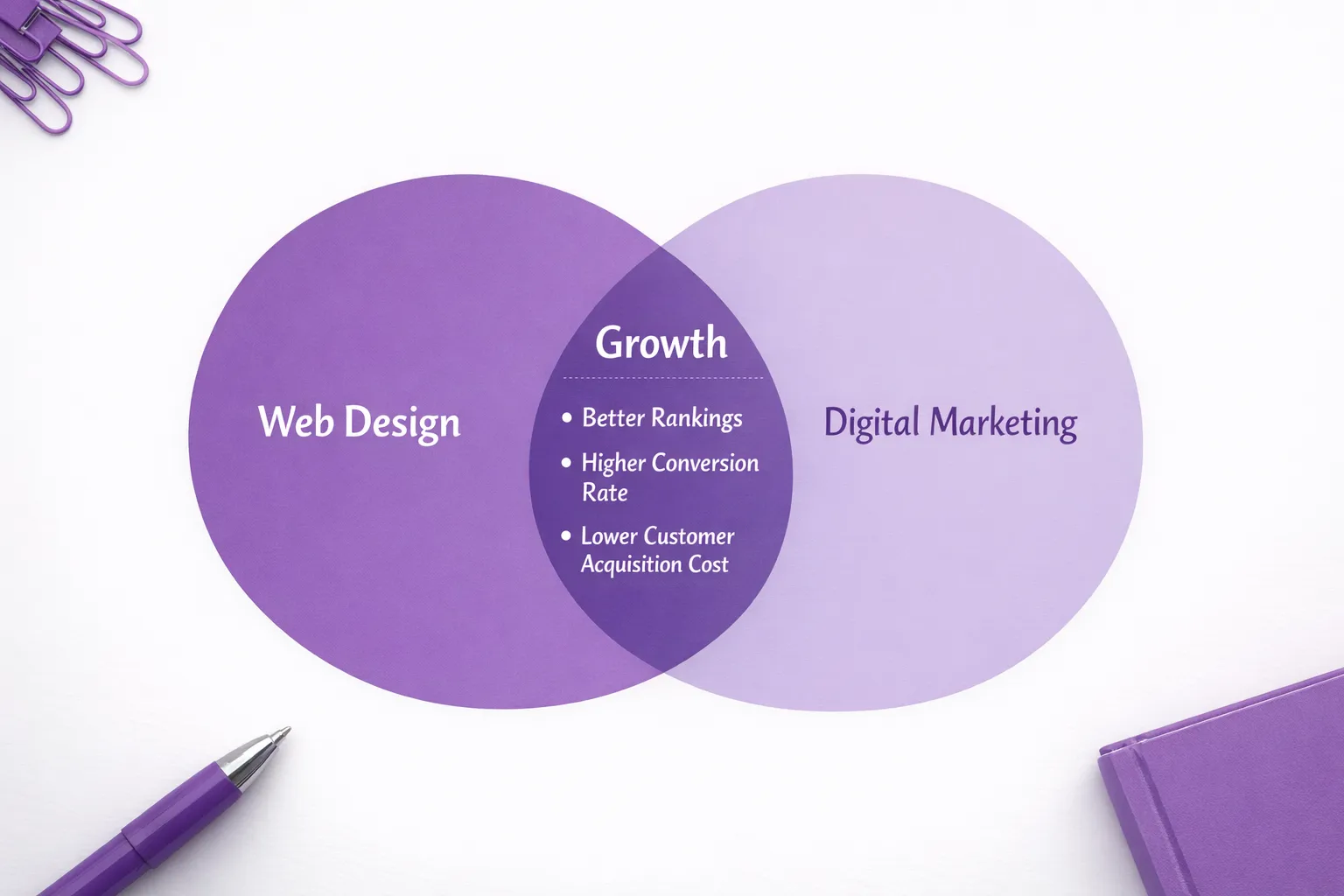
Why website design and digital marketing are better together
When design and marketing move in lockstep, you build one system that attracts, persuades, and converts. Here are the core reasons this matters for small local businesses and non technical founders.
Speed and Core Web Vitals power both UX and visibility
Fast sites reduce bounce and improve conversion. They also align with Google’s page experience guidance. Google recommends focusing on Core Web Vitals because they reflect real user experience, which is fundamental to success in Search, even though they are not a stand‑alone ranking system. See Google’s documentation on page experience and Core Web Vitals.
- What it means in practice: design decisions like image formats, layout shifts, and code weight are marketing decisions, because they directly impact how many visitors stay long enough to purchase or contact you.
UX clarity turns traffic into revenue
Clear navigation, readable typography, and obvious calls to action lift conversion rates. Research synthesized by Nielsen Norman Group shows strong ROI from usability improvements, because better UX reduces friction and abandonment across the funnel. Read NN/g on the ROI of UX.
- What it means in practice: wireframes and content hierarchy should be built from search intent and conversion paths, not just aesthetics.
Content and on page SEO need a layout made for ranking and reading
Search optimized content still has to be consumed by humans. Templates should support scannable headings, FAQ blocks, internal links, and structured data. When the CMS and components are built for this on day one, publishing becomes faster, and results come sooner.
Data flows make smarter decisions
A site designed with analytics, events, and CRM connections lets you answer real questions, for example which service pages drive calls, what keywords lead to booked appointments, which ad campaigns produce higher lifetime value. That is how marketing budgets get reallocated to what works.
What the synergy looks like on a local business website
Below is a practical checklist that shows how website design choices map to marketing outcomes and what to measure.
| Design decision | Marketing impact | Metric to watch | How to measure |
|---|---|---|---|
| Lightweight theme and optimized images | Lower bounce, better engagement | Largest Contentful Paint, bounce rate | Core Web Vitals, analytics |
| Clear service navigation with city pages | Higher relevance for local searches | Organic clicks, local rankings | Search Console, Google Business Profile |
| Prominent calls to action on every page | More leads without more traffic | Conversion rate, calls, form submissions | Analytics, call tracking |
| Review badges and social proof blocks | Increased trust and selection rate | Click to call, route requests | Analytics, Google Business Profile |
| Accessible color contrast and font sizes | Wider audience reach, lower abandonment | Session duration, task completion | Accessibility audit, analytics |
| Schema markup for LocalBusiness and FAQs | Enhanced search appearance | Impressions, rich results | Search Console |
A few details that matter in Los Angeles and the Inland Empire:
- Service area content, write city specific pages that reflect neighborhoods, landmarks, and parking realities that locals actually search for.
- Google Business Profile integration, show consistent NAP, hours, and map links. Google explains local ranking factors as relevance, distance, and prominence, see Improve your local ranking on Google.
- Reviews and reputation, BrightLocal’s 2024 survey shows most consumers read reviews for local businesses, which makes how you display and request reviews a conversion lever. See the Local Consumer Review Survey.
- Bilingual options where appropriate, many LA audiences value English and Spanish content for clarity and trust.
- Accessibility as a norm, follow WCAG so everyone can use your site and you reduce legal risk while improving UX for all.
A simple integrated blueprint for the next 90 days
You do not need a giant team or enterprise budget to ship an integrated system. Use this sequence to stack wins.
Phase 1, Strategy and goals
Define your primary action, call, book, buy, and outline the top three services you want to rank for in your city. Interview customers to capture their language and objections.
- Deliverables: goal metrics, keyword and intent map, site architecture, wireframes, and a content plan.
Once you have a plan, you will know what to build and what to ignore.
Phase 2, Build the foundation
Develop a fast site on a modern stack or CMS you can maintain. Set up analytics and consent, create conversion events, install call tracking, and connect forms to your CRM so no lead slips through the cracks.
- Deliverables: mobile first templates, Core Web Vitals optimization, service and city pages, schema markup, CRM and workflow automation.
This is where design and marketing meet, because the components you ship will determine how quickly you can run campaigns later.
Phase 3, Launch with intent
Publish content that answers real questions from searchers, include internal links and FAQ blocks that match common queries. Update your Google Business Profile with fresh photos, offers, and posts. Seed the first five to ten reviews.
- Deliverables: on page SEO, GBP updates, review request system, email nurture for new leads.
Plan a two week stabilization period to watch speed, crawl, and conversion data before heavy ad spend.
Phase 4, Optimize and scale
Use analytics to double down on what works, improve underperforming pages, and expand into adjacent neighborhoods or services. Consider targeted ads only after the funnel converts at an acceptable cost.
- Deliverables: A B tests for headlines and CTAs, content expansion, local link outreach, budget reallocation by channel performance.
Budget, ROI, and timelines for non technical founders
- Timelines, many local sites can move from strategy to launch within 6 to 10 weeks if approvals are fast and content is ready.
- ROI math, track three numbers, traffic, conversion rate, and value per lead or order. Small lifts compound. For example, a 20 percent traffic increase and a 20 percent conversion lift yields a 44 percent bump in revenue.
- Speed pays off, Deloitte reported that a 0.1 second improvement in mobile site speed increased retail conversions by 8 percent on average. See Milliseconds Make Millions.
The key is to set a baseline before changes, then measure weekly in the first month after launch. Without a baseline, you will not know if your investment worked.
Common pitfalls to avoid
- Launching without analytics, events, and call tracking, you will be flying blind.
- Choosing a heavy theme or plugins that slow down mobile, visitors will bounce before they see your offer.
- Publishing content that ignores search intent, traffic without relevance will not convert.
- Forgetting local basics, inconsistent NAP or thin city pages make it hard to rank locally.
- No follow up automation, if leads sit in an inbox for days, your marketing dollars are wasted.
E commerce or lead gen, the integration principles are the same
Whether you sell online or book appointments, the stack should connect the dots.
- E commerce, prioritize fast PDPs with rich media that does not shift layout, clear shipping and returns content, and a frictionless checkout. Use structured data so products surface correctly.
- Lead generation, shorten forms, let users book time directly, and connect submissions to a CRM that triggers immediate notifications and nurture sequences.
The design decision is the marketing decision because everything shapes time to value for your visitor.
How this aligns with Google’s guidance
Google repeatedly emphasizes creating helpful, people first content and great page experience. Review their guidance on page experience and helpful content principles. Building your site around these ideas puts you on solid ground for sustainable growth.
Frequently Asked Questions
Do I need SEO if I am running ads? Yes. Ads can bring quick traffic, but SEO and a conversion ready site lower acquisition costs over time. Most businesses do best with both, use ads to test offers and keywords, then build organic pages that convert.
How long until a new site impacts rankings and leads? Technical improvements and conversion lifts can be immediate. Meaningful organic growth usually takes 2 to 3 months for local terms once content and Google Business Profile are optimized, and can accelerate from there.
What is the difference between web design and development? Design focuses on how pages look and guide users. Development implements the code and systems that make it fast, secure, and editable. For growth, these work together with content and SEO.
Should I redesign or improve what I have? If your current site is slow, hard to edit, or lacks the templates you need for service and city pages, a rebuild can be faster and cheaper than endless patches. If the foundation is solid, iterate.
How do we measure ROI on a website project? Track baseline traffic, conversion rate, and value per lead or order. Connect forms and calls to a CRM so revenue can be attributed to channels. Review these weekly after launch.
What about accessibility, will it help SEO? Accessibility reduces friction for all users and often improves structure and performance. It is good for people and good for business, and it aligns with best practice standards like WCAG.
Do reviews really impact local visibility and conversions? Yes. Reviews contribute to prominence in local search and increase trust. BrightLocal’s research shows reviews influence selection. Build a simple system to request and showcase them.
Bring design and marketing together with a local team
If you are a small business or startup in Los Angeles or the Inland Empire, you do not need separate vendors for design, development, and marketing. You need one plan, one build, and one team accountable for results. Brother Web Design is an in house team that delivers custom web design, app and e commerce development, workflow automation, CRM integration, lead generation, SEO and local optimization, ongoing support, and integrations with the tools you already use. If you are ready to align website design and digital marketing into one growth plan, connect with the local team at Brother Web Design.
References and further reading:
- Google Search Central, Page experience guidance
- web.dev, Core Web Vitals
- Deloitte, Milliseconds Make Millions
- Nielsen Norman Group, The ROI of UX
- Google Support, Improve your local ranking on Google
- BrightLocal, Local Consumer Review Survey
- schema.org, LocalBusiness structured data
- Google Search Central, Creating helpful, reliable, people first content