If you are a local business in Los Angeles or the Inland Empire, your website has one job: turn nearby searches into phone calls, form submissions, and booked appointments. The catch is that “a nice-looking site” is not the same thing as a site that ranks locally and converts.
The best results usually come when SEO and web design services are planned together, not bolted on later. That is how you build pages that Google can understand, locals can trust, and customers can act on quickly.
What “SEO-ready web design” actually means for local lead generation
For local businesses, you are not trying to win the whole internet. You are trying to win:
- “near me” searches
- city and neighborhood searches (Los Angeles, El Monte, Rowland Heights, Pomona, etc.)
- service + intent searches (emergency, same-day, affordable, best, open now)
That requires more than sprinkling keywords into headings. It requires a website that is:
- Crawlable and indexable (search engines can reach and understand important pages)
- Fast and mobile-first (most local searches happen on phones)
- Structured by services and locations (clear topical signals)
- Built to convert (calls, bookings, quotes, store visits)
A clean design supports all of that, but conversion and visibility have to be designed into the foundation.
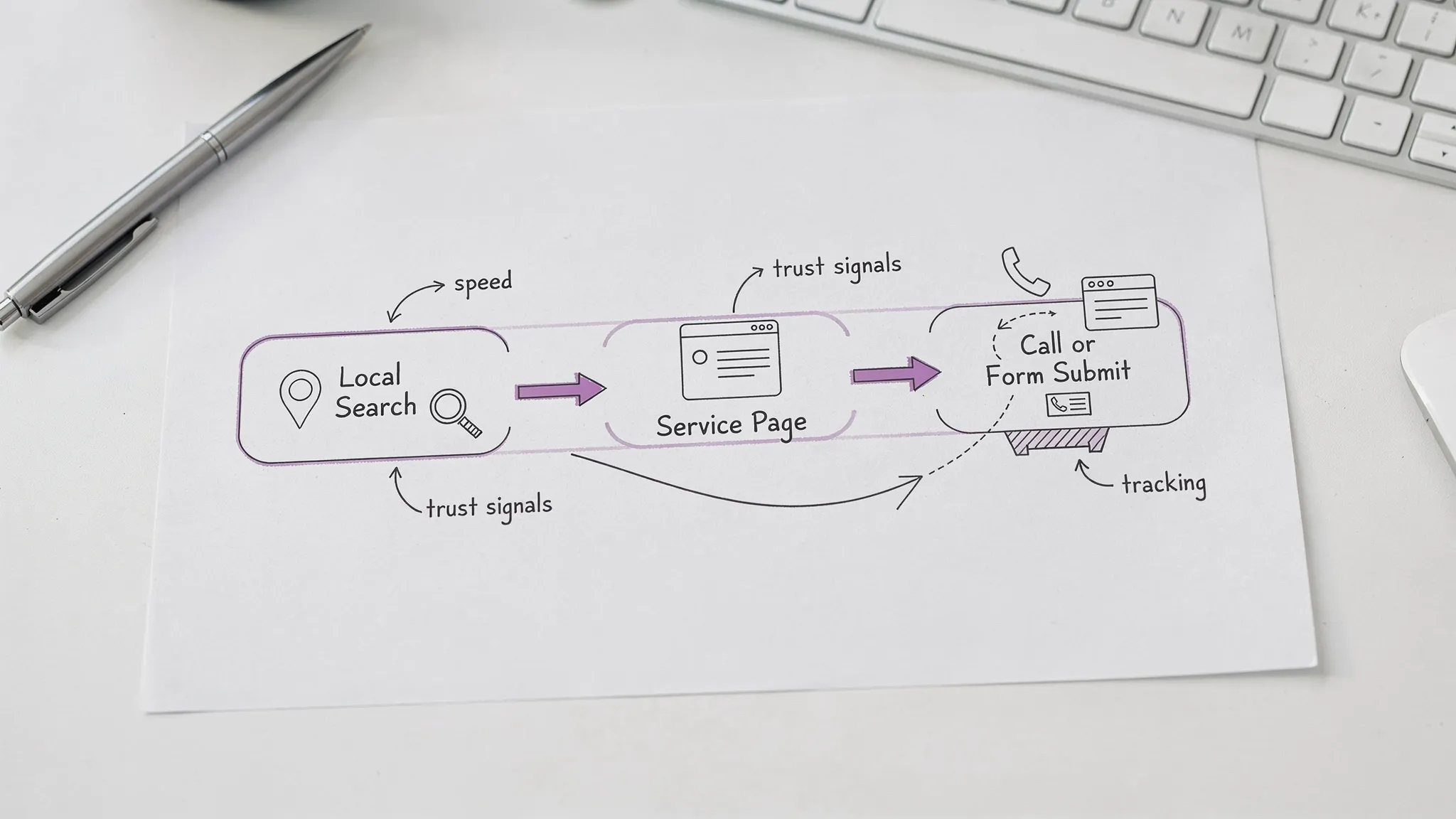
The local lead funnel (and what your site must do at each step)
Local SEO is often described as rankings, but rankings are just the beginning. A high-performing local site supports a full funnel: discovery, trust, and action.
| Funnel stage | What people are doing | What your SEO + web design should deliver |
|---|---|---|
| Search | Looking for a provider nearby | Location-aware pages, strong titles/meta, relevant service content |
| Compare | Checking options quickly | Fast load, clear offer, scannable layout, proof (reviews, photos) |
| Contact | Trying to reach you now | Click-to-call, short forms, easy booking, clear hours and service area |
| Decide | Confirming you are legit | Licensing/insurance, testimonials, case examples, guarantees/policies |
| Return | Saving you for later | Email/SMS capture, remarketing-ready tracking, helpful resources |
When SEO and web design are disconnected, you might rank but fail to convert, or convert well but never get enough traffic.
Web design elements that directly impact local SEO
1) Site architecture built around services and locations
A common local-business mistake is having one “Services” page that tries to cover everything. A better approach is to create a clear structure:
- A main Services hub
- Individual service pages (each with its own intent and FAQs)
- Location or service-area pages when it’s legitimate and useful (not thin duplicates)
This helps Google understand what you do, and it helps customers self-qualify quickly.
2) Mobile UX that matches “call now” behavior
Local traffic is high-intent. People want a fast answer and a fast action.
Mobile-first design should include things like thumb-friendly buttons, readable type, and short sections that load quickly. Google also evaluates mobile usability and performance as part of page experience signals (see Google’s guidance on Core Web Vitals).
3) Technical SEO basics that should be baked into the build
Good-looking sites can still be invisible if technical fundamentals are ignored. SEO-forward web design typically includes:
- Clean URL structure (simple, consistent, not auto-generated junk)
- Proper heading hierarchy (one clear H1, logical H2s)
- Indexability controls (no accidental “noindex” on money pages)
- XML sitemap and robots.txt setup
- Image compression and next-gen formats where appropriate
- Schema markup (for example: LocalBusiness, Organization, Service)
If you are non-technical, the simplest way to think about this is: your site should be easy for Google to read, the same way it is easy for a person to read.
4) Content blocks designed for local intent
Local prospects usually have specific questions:
- Do you serve my area?
- How fast can you come out?
- What does it cost (even a range)?
- Can I trust you in my home or with my payment?
Your design should make room for those answers near the top of the page, not buried in a footer link.
SEO elements that directly increase local leads (not just traffic)
Local landing pages that convert
A local landing page is not just a city name stuffed into paragraphs. A lead-focused page typically includes:
- A clear headline (service + outcome)
- Primary CTA (call, quote, booking)
- Proof (reviews, before/after, photos, badges)
- Specific service details (what’s included, what’s not)
- Service area clarity (neighborhoods, travel fees if relevant)
- FAQs that match objections
If you sell a specialized product or guide, this same idea applies. For example, a page like FixHome Guides works because it’s built around a clear problem, a step-by-step promise, and an easy next step to purchase. Local service businesses can borrow that same “make it simple and visual” approach for quote requests and bookings.
Google Business Profile and on-site alignment
Your Google Business Profile (GBP) often drives calls before someone even reaches your website, especially in map results. Your site should support that listing by matching:
- Business name formatting
- Service categories and service descriptions
- Service areas and hours
- NAP consistency (name, address, phone)
Google’s own overview of local listings is a good reference point: Google Business Profile.
Review strategy that supports conversion
Reviews are not only an SEO factor, they are a conversion factor. A strong local site makes reviews visible where decisions happen, such as on:
- The homepage (in moderation)
- Service pages
- Contact page
Also, make it easy to ask for reviews after a job is completed (email or SMS automation helps, but even a simple process can work).
Tracking that tells you which pages create leads
If you are paying for SEO and web design services, you should know what is working.
At minimum, make sure your build supports:
- Form tracking (thank-you page or event tracking)
- Click-to-call tracking on mobile
- Location-based performance in Google Search Console
If you want a practical, non-technical walkthrough of using real data to guide improvements, this pairs well with Brother Web Design’s guide on how to optimize your website using search and analytics data.
What to look for in SEO and web design services (deliverables that matter)
Many proposals sound good but stay vague. Here is a plain-English way to evaluate a provider.
| Area | Good deliverable | Why it boosts local leads |
|---|---|---|
| Strategy | Page map for services and locations | Prevents thin pages, clarifies what should rank |
| Design | Mobile-first layouts with conversion sections | Makes it easy to call, book, or request a quote |
| Performance | Speed plan (image handling, caching, lightweight build) | Reduces bounce, improves user experience |
| On-page SEO | Titles, headings, internal links, FAQs | Matches local intent and improves relevance |
| Local SEO | GBP support + NAP consistency guidance | Strengthens map visibility and trust |
| Technical SEO | Indexability checks + sitemap setup | Ensures Google can actually find key pages |
| Tracking | Call/form tracking plan + reporting cadence | Lets you measure lead growth, not opinions |
| Maintenance | Updates, security, content edits | Keeps rankings and conversions stable over time |
If you want a deeper view of what a full-service build should include, this is closely related to what small businesses should expect from web design services, but the key is insisting on local lead outcomes, not just a “launch.”
Common mistakes that block local leads (even when the site looks great)
You send all traffic to the homepage
Homepages are rarely the best place to rank for specific services. If you only have a homepage and a contact page, you force every search intent into one generic page.
Your CTAs are unclear or too slow to access
Local visitors are often in a hurry. If your phone number is not tappable, your forms are long, or your booking option is hidden, you will lose leads even with good traffic.
You launch without local proof
For service businesses especially, trust is the currency. If you are missing reviews, photos of your work, licensing, insurance notes, or clear policies, prospects hesitate.
You “do SEO” but ignore conversion
Rankings without conversions create the illusion of marketing success. A lead-focused approach treats each key page like a salesperson: answer questions, show proof, and make the next step obvious.
A quick self-audit for local businesses (10 minutes)
Open your website on your phone and ask:
- Can I understand what you do in 5 seconds?
- Is there a clear button to call or request a quote?
- Do you show your service area and hours clearly?
- Do service pages exist for your top 3 to 5 services?
- Do you show reviews or proof near the CTA?
- Does the page load quickly on cellular data?
If you answered “no” to two or more, you probably do not need “more marketing” yet. You need your website and SEO foundation aligned.
Frequently Asked Questions
Do I need SEO before I redesign my website? If your site is being rebuilt, it’s usually best to include SEO in the redesign plan. Redirects, page structure, on-page content, and tracking are easier and cheaper to do during the build than after launch.
How long does it take for local SEO to produce leads? It depends on your competition, your current site, and how complete your local presence is (Google Business Profile, reviews, service pages). Some businesses see early wins in weeks, but consistent gains usually take a few months of building relevance and trust.
What’s the difference between a template site and a custom site for local SEO? Templates can work for very simple needs, but custom builds make it easier to tailor pages around your specific services, service areas, conversion flow, and performance requirements. For local lead generation, those details often matter.
Should I create a page for every city I serve? Only if the pages are genuinely useful and unique. Thin “copy-paste city pages” can hurt quality. A better approach is to focus on strong service pages, then add location pages where you can include real local proof, project examples, and area-specific details.
What should I track to measure local lead growth? Track calls (especially click-to-call), form submissions, booking completions, and which pages generate those conversions. Rankings are useful, but lead actions are the real KPI.
Get a local-lead website plan (without the tech overwhelm)
If you are a small business owner or non-technical founder, you should not have to translate between “design talk” and “SEO talk” just to get a site that generates leads.
Brother Web Design builds and supports SEO and web design services for local businesses in the Los Angeles and Inland Empire area, with a focus on custom builds, local optimization, and conversion-first structure.
If you want, share your current website and your top services, and we can map out which pages you actually need to rank locally and where your site is losing leads today. Visit Brother Web Design to start the conversation.