
Choosing a web development company is one of those decisions that looks simple (pick a nice portfolio, get a quote) but quickly becomes high-stakes once you realize your website is tied to revenue, reputation, and operations.
For small businesses and nontechnical founders, the goal is not to “hire developers.” The goal is to hire a partner that can translate business outcomes (more calls, more booked appointments, more sales, less manual work) into a site that is fast, secure, easy to update, and built to be found.
What “web development company” should mean in 2026
A true web development company in US should be able to cover more than visuals. At minimum, they should understand:
- Conversion fundamentals (clear offers, calls to action, forms that work, trust signals)
- Technical performance (speed, mobile UX, Core Web Vitals)
- Security and maintenance (updates, backups, monitoring)
- Search readiness (technical SEO, local optimization if you serve an area)
- Integrations (CRM, email marketing, scheduling, payments, inventory)
If a provider is mostly selling “a homepage design” or “a template with your logo,” that is closer to basic design production than development.
If you want a deeper breakdown of what a professional partner should deliver, this checklist-style guide is helpful: Web Design Services: What Small Businesses Should Expect.
Step 1: Get specific about what you are buying
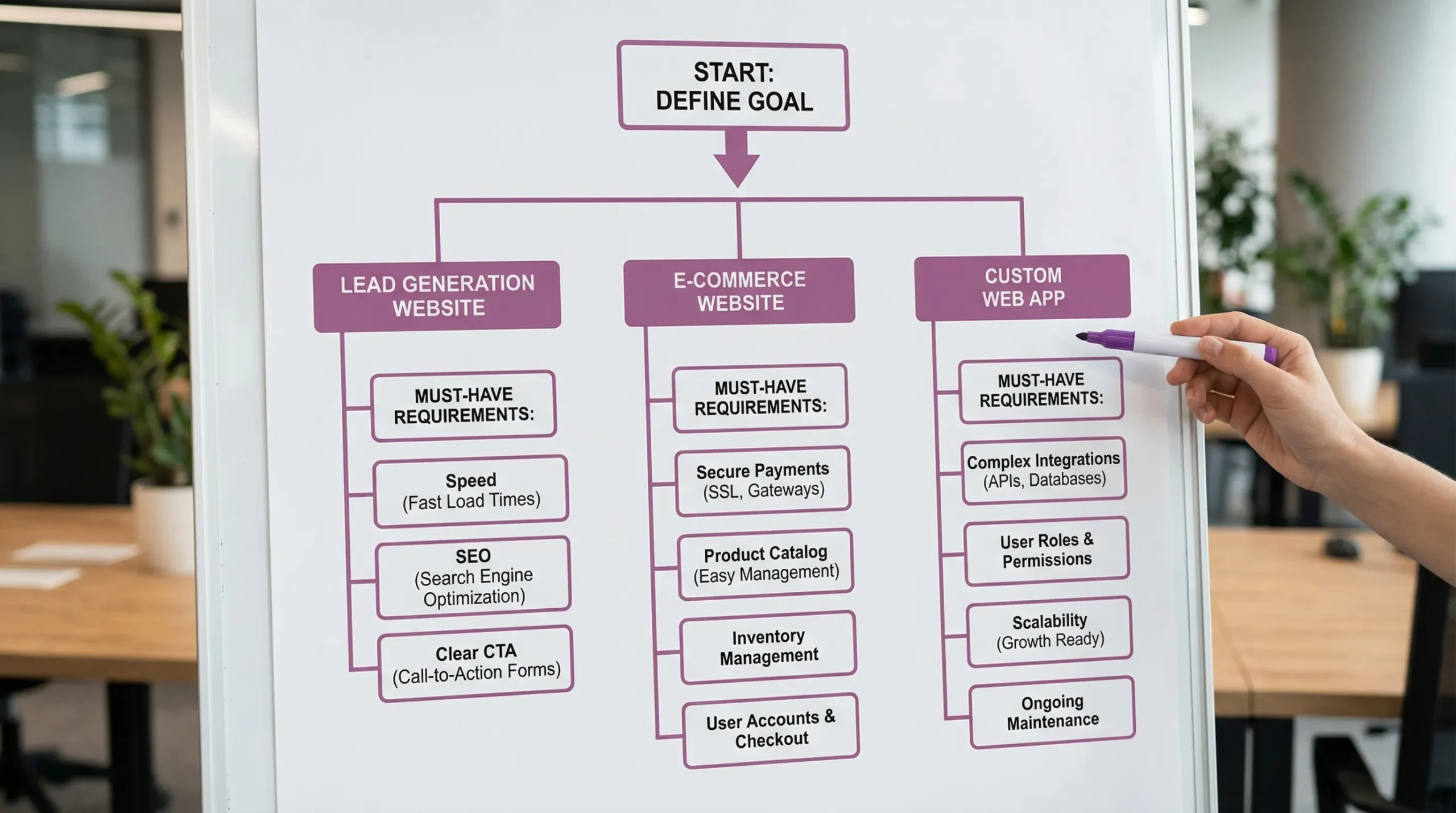
Before comparing vendors, define the job your website must do. Most small businesses fit into one of these buckets:
Lead generation site
You need calls, form fills, booked appointments, quote requests.
Key requirements:
- Landing pages for services and locations
- Tracking (analytics, call tracking, form conversion tracking)
- Fast mobile experience
- Strong local SEO foundation
E-commerce
You need product discovery, checkout reliability, and operational efficiency.
Key requirements:
- Product taxonomy and filters
- Shipping and tax setup
- Payment and fraud handling
- Email flows and abandoned cart support
Web app or custom tool
You need software, not just a website.
Key requirements:
- Authentication and roles
- Database design
- Integrations (CRM, accounting, inventory)
- QA, staging environments, and ongoing support
When you clearly name the outcome, you can quickly eliminate providers who do not build that kind of system.
Step 2: Decide whether “US-based” is a requirement and why
Many teams can build a website, but there are practical reasons businesses specifically seek a web development company in US:
- Time zone overlap for faster approvals, troubleshooting, and launches
- Clearer accountability on contracts, support, and ongoing maintenance
- Better understanding of US market expectations (local search behavior, accessibility expectations, trust signals)
- Easier collaboration if your project includes iterative strategy, copy, and marketing alignment
US-based does not automatically mean better, but it often reduces risk for nontechnical owners who need real-time communication.
Step 3: Evaluate proof the right way (not just “a nice portfolio”)
A portfolio shows taste, but you also need evidence of execution.
Ask for case studies that include the “why”
Good examples explain:
- What problem the business had
- What changed (structure, copy, speed, SEO, integrations)
- What the results were (more calls, more bookings, higher conversion rate)
If the vendor cannot articulate the strategy behind the build, you may end up paying for visuals without business impact.
Look at performance and fundamentals yourself
You do not need to be technical. You can still check:
- Does the site load quickly on mobile?
- Are calls to action obvious?
- Is the navigation simple?
- Does the site feel trustworthy (reviews, photos, policies, real contact info)?
If you want an example of a professional services site that must communicate trust and clarity, look at how a medical practice frames services, team credibility, and appointment options. For instance, Comprehensive Psychiatric Services in NYC shows how a specialized provider can present multiple services and pathways (in-person and telehealth) without overwhelming the user.
Step 4: Demand a clear process (this is where projects succeed or fail)
For small businesses, the biggest risk is not “bad code.” It is unclear scope and unclear decisions, which leads to delays and surprise costs.
A solid process usually includes:
Discovery and planning
This should cover goals, target customers, competitor scan, required integrations, and conversion paths. If a company skips discovery and jumps to mockups, expect rework.
Content and information architecture
Your pages and messaging should be mapped before design is finalized. Otherwise, the site becomes a pretty container with weak copy.
Design and development
Ask how many revision rounds are included, and how feedback is collected.
QA and launch
This should include mobile testing, form testing, speed checks, backups, and basic security hardening.
Post-launch support
Most sites need adjustments after real users start interacting.
If you are considering a recurring plan vs a one-time build, this can help you compare options: Web Design as a Service: Pricing and Plans.
Step 5: Check the technical quality that protects you long-term
Nontechnical founders often judge quality by appearance. In reality, long-term value comes from the boring stuff.
Performance (speed)
Speed impacts conversions and SEO. Google’s Core Web Vitals are a common baseline for measuring real user experience.
Ask:
- What is your speed target on mobile?
- How do you optimize images, scripts, and fonts?
- Do you test on real devices or only in a browser?
Accessibility
Accessibility is both the right thing to do and a risk reducer. Ask if they build toward WCAG guidance (many teams aim for WCAG 2.2 AA). The US reference point for accessibility enforcement is commonly tied to ADA-related expectations.
Security and ownership
At minimum, you should know:
- Who owns the domain, hosting, and admin accounts (it should be you)
- Whether you will have full access to the CMS and code repo (if applicable)
- What updates, backups, and monitoring exist after launch
Step 6: Make sure SEO is built in (not bolted on)
A common mistake is launching a site that looks good but has no search foundation.
A web development company in US that understands small business growth should cover:
- Technical SEO (indexing, sitemaps, canonical handling, redirects)
- On-page structure (titles, headings, internal linking, schema where relevant)
- Local optimization (service areas, Google Business Profile alignment, reviews strategy)
- Tracking (Search Console, analytics, events for forms and calls)
If you are trying to decide whether you should hire a team or DIY your site, this comparison is practical: Website Building Company vs DIY: Pros and Cons.
Step 7: Confirm they can handle integrations (the hidden ROI)
For many local businesses, the website is only step one. The real ROI comes from reducing manual work and improving follow-up.
Ask whether they can support:
- CRM integration (web-to-lead, pipeline stages, notifications)
- Scheduling and appointment tools
- Payments, invoicing, and e-commerce workflows
- Automations (missed call text-backs, follow-up sequences)
If integrations matter to you, you can also review: CRM Software: Features Small Teams Really Need.
A simple comparison table to choose the right type of vendor
Different vendor types can be valid, but they fit different risk profiles.
| Option | Best for | Common upside | Common risk |
|---|---|---|---|
| Solo freelancer | Very small, simple sites with clear scope | Lower cost, direct communication | Limited bandwidth, single point of failure |
| Boutique US team | Small businesses that need strategy + execution | Faster feedback loops, better continuity | Can book up quickly, scope must be managed |
| Large agency | Complex brands with big budgets and multiple stakeholders | More specialists, robust processes | Higher cost, slower turnaround |
| Overseas dev shop | Teams with strong internal product management | Cost savings, larger teams | Time zone friction, inconsistent communication if not managed |
Questions to ask before signing a contract
These questions reveal maturity quickly.
“What does success look like 60 days after launch?”
You want a vendor who talks about outcomes (leads, bookings, conversion rate, search visibility), not just “site delivered.”
“What are the deliverables, exactly?”
You should see clarity on pages, features, integrations, and what is not included.
“Who is on the team and who do I talk to weekly?”
If you only meet a salesperson and never meet the builders, that can be a problem.
“What will I own at the end of the project?”
The correct answer is: you own the domain, the hosting accounts, the site files, and the admin access.
“What happens after launch?”
Ask about support, response times, and what maintenance includes.
Red flags that usually cost small businesses money
These patterns often lead to overruns or underperformance:
- No discovery phase, they quote after a 10 minute call
- No mention of speed, accessibility, or SEO basics
- Vague timelines, vague deliverables
- They will not give you admin access, or they register the domain for you under their account
- Every request is a “change order” because scope was never defined

If you are in Los Angeles or the Inland Empire, add one more filter
Local businesses often need:
- Service area pages and localized SEO
- Calls and form leads routed correctly
- Fast turnaround when promotions or seasonal services change
- A team that understands local competition and customer expectations
A local US-based dev team can be especially valuable if you want collaboration and fast iteration, not just a one-time build.
Frequently Asked Questions
How much does it cost to hire a web development company in US? Pricing depends on scope (custom design vs template, number of pages, integrations, e-commerce, custom features) and ongoing support. Ask for a line-item scope so you can compare quotes fairly.
Should I hire locally or can I hire anywhere in the US? If you need frequent collaboration, quick changes, or you are not technical, local or same-time-zone teams often reduce delays. If your scope is very clear, a remote US team can work great.
What is more important, design or development? Both matter, but for business results, development quality (speed, SEO foundation, tracking, integrations, reliability) often determines whether the site generates leads consistently.
How do I know if a company will build an SEO-friendly site? Ask what they include for technical SEO, how they structure pages and headings, whether they set up Search Console and analytics, and how they handle redirects during launch.
Who should own my domain and hosting? You should. A reputable company can manage it for you, but accounts should be in your name with your access.
Talk to a US-based team that builds for growth
If you want a site that is more than a digital brochure, Brother Web Design builds custom websites, e-commerce, and business automation for small businesses and startups, with a collaborative process and ongoing support.
Explore options at BrotherWebDesign.com and share what you are trying to build. We will tell you what’s realistic, what to prioritize first, and what it should cost based on scope.