If you run a local business, “modern website design” is not about chasing whatever looks trendy on Dribbble. It’s about building a site that loads fast on mobile, communicates trust in seconds, and makes it easy for a real person in your service area to call, book, or buy.
In 2026, the best local brand sites feel simple on the surface, but they’re built with a modern stack of fundamentals underneath: performance, accessibility, local SEO signals, conversion paths, and integrations that keep leads from slipping through the cracks.
What “modern website design” actually means for local brands
Modern design is often described in visual terms (clean layouts, strong typography, tasteful motion). For local brands, modern is more practical:
- Instant clarity: What you do, where you do it, and how to take the next step.
- Speed as a feature: Your site should feel immediate, especially on phones.
- Trust built in: Reviews, licensing, guarantees, real photos, clear policies.
- Frictionless conversion: Click-to-call, booking, “request a quote,” direction taps.
- Scalable content: Pages you can expand without breaking the design.
A good rule: if a first-time visitor can’t tell you’re the right option within 10 seconds, the site isn’t modern, even if it looks polished.
Trend 1: Performance-led design (Core Web Vitals-first layouts)
Local customers are often searching on cellular data, between errands, or while comparing 2 to 3 businesses. Performance is part of the design now.
Google’s own research found that as mobile page load time goes from 1 to 3 seconds, the probability of bounce increases by 32% (Think with Google).
What performance-led design looks like in practice:
- Lean page sections instead of giant sliders
- Fewer heavy third-party scripts (or loading them later)
- Modern image formats and responsive sizing
- Fonts that don’t cause layout shifts
If you’re evaluating a redesign, ask your developer how they plan to protect Core Web Vitals, not just “make it look clean.”
Trend 2: “Local proof” above the fold (not just a hero banner)
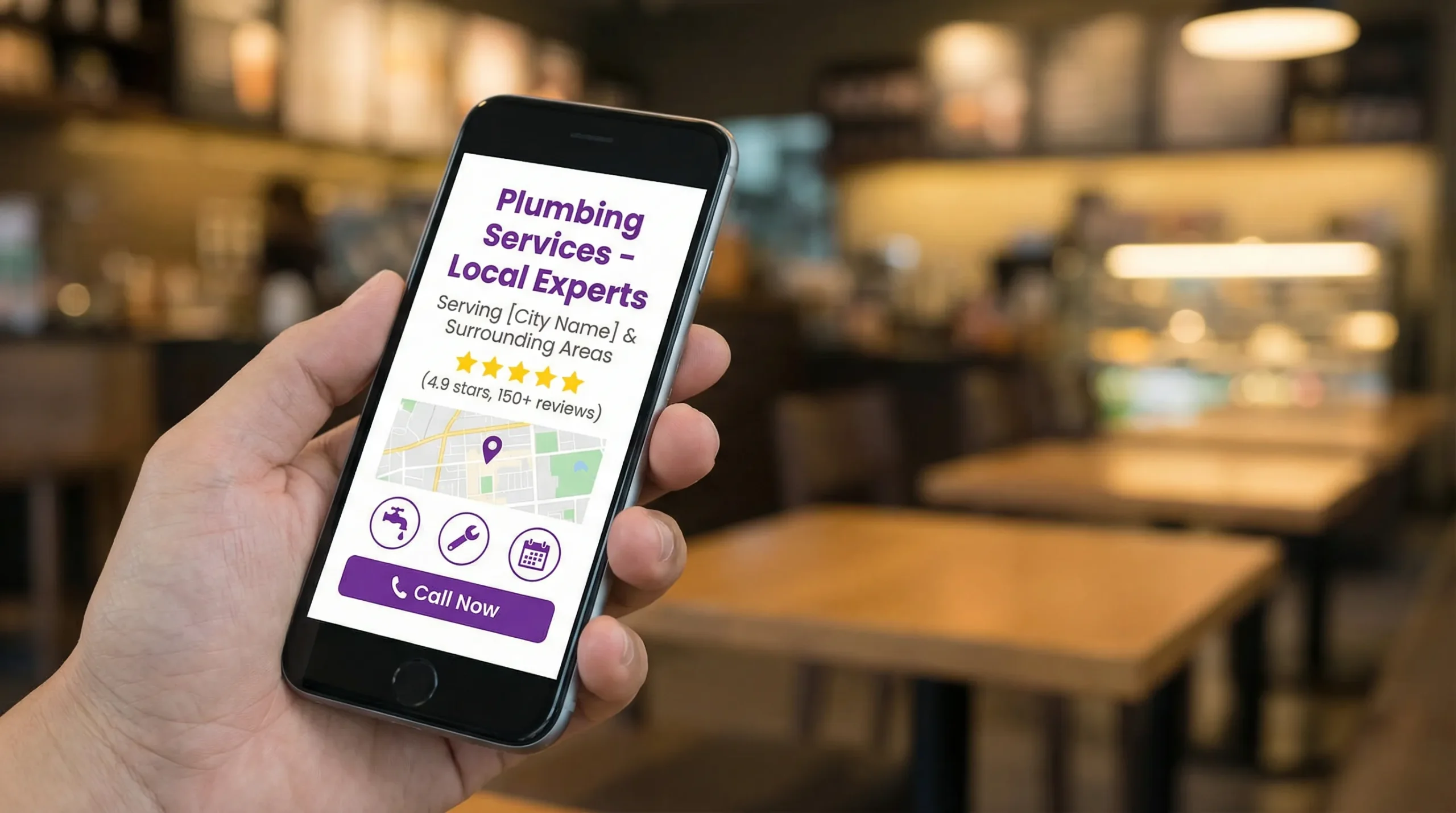
A modern local homepage isn’t a big photo with a vague slogan. It’s a compact trust and intent panel.
Strong above-the-fold patterns for local brands:
- Primary CTA (Call, Book, Get Quote)
- Short service statement (what you do)
- Location qualifier (city, area served)
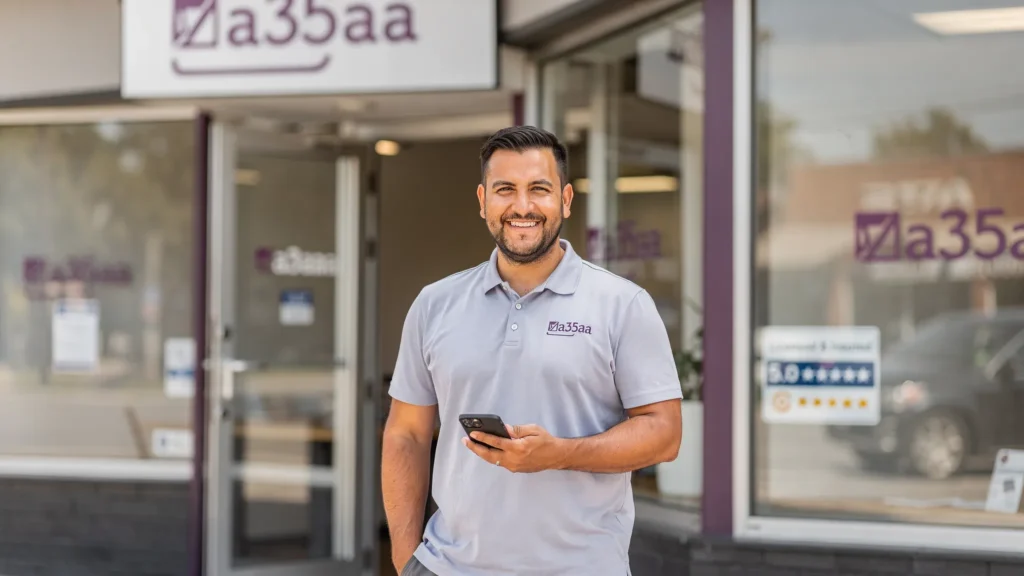
- Review snapshot (rating, platform, count)
- Trust badges (licensed, insured, years in business, associations) where relevant
This is design doing sales work, without feeling salesy.
Trend 3: Real photography and “human-scale” branding
Stock photography is increasingly easy to spot, and it can quietly reduce trust. For local brands, modern website design is moving toward real team, real shop, real work.
You don’t need a huge photoshoot. You need:
- 10 to 25 authentic images used consistently
- One strong “proof” gallery (before/after, installs, projects, arrangements, job sites)
- A simple brand system (2 fonts, 2 to 3 colors, repeatable components)
Local customers want to know who they’re hiring, not just what you sell.
Trend 4: Conversion micro-moments (designing for taps, not tours)
Many local visitors won’t read your full site. They’ll do micro-actions:
- Tap to call
- Tap for directions
- Tap to text
- Check pricing range
- Verify service area
- Confirm availability
Modern designs support this behavior with:
- Sticky call or booking buttons on mobile
- Short “Next step” modules repeated on key pages
- Clean contact pages (hours, address, map, parking notes, service radius)
- Clickable phone numbers everywhere
This is especially important in LA and the Inland Empire, where people are often searching while commuting or between appointments.
Trend 5: Accessibility as a brand standard (and risk reducer)
Accessibility is no longer a niche requirement. It’s part of modern quality.
The World Health Organization estimates 1.3 billion people live with a significant disability (WHO). Accessible design helps those users, and it also improves readability and usability for everyone.
Modern accessibility-forward patterns:
- High-contrast text and buttons
- Larger tap targets and spacing
- Visible focus states for keyboard users
- Clear headings and consistent page structure
If you want a concrete benchmark for web accessibility, the industry commonly references WCAG.
Trend 6: Modular, component-based pages (so the site can grow)
A lot of small businesses outgrow their website not because the brand changes, but because the site can’t scale without becoming messy.
Modern websites are built more like “systems”:
- Reusable sections (testimonials, service blocks, FAQs embedded inside pages, team cards, pricing cards)
- Consistent spacing and typography rules
- Templates for service pages, location pages, and case studies
This matters if you plan to expand into new neighborhoods, add services, or publish content for SEO.
Trend 7: Local SEO baked into the design, not bolted on later
Design choices can either strengthen or sabotage your local visibility.
Modern local-focused design includes:
- Service pages that answer intent clearly (not one generic “Services” page)
- Location cues in the interface (service area module, embedded map, consistent NAP where appropriate)
- Schema-ready structure (for example, clear business info, reviews, services)
- Clean internal linking between related services and locations
This is where a local dev team has an advantage: they can design the pages around how people actually search in your market, instead of designing first and “SEO-ing” later.
Trend 8: Integration-minded design (forms are just the beginning)
For non-technical founders, the biggest modern shift is this: the website is no longer a standalone brochure. It’s the front door to your systems.
Modern sites are designed so leads flow somewhere useful:
- CRM or pipeline
- Email/SMS follow-up
- Booking calendar
- Quote or invoice tools
Even simple improvements like routing “Request a Quote” forms into the right inbox, tagging lead sources, or triggering a fast follow-up can change your close rate.
Brother Web Design positions this as part of the build (custom sites plus workflow automation, CRM development, lead generation, and ongoing support), which is often what local businesses need when the site is expected to produce revenue, not just look good.
Trend 9: Content that stays fresh without becoming a second job
Modern website design trends for local brands also include a practical content strategy: updates that show Google and customers you’re active, without requiring you to become a full-time writer.
Two approaches work well:
- Small, consistent posts: project updates, seasonal promos, new inventory or service announcements
- Evergreen local pages: “Service + City” pages, comparison pages, pricing explainers, common problems
If you want to scale content without hiring an in-house writer, an autopublishing tool can help. Some teams use an AI platform like BlogSEO to generate and publish SEO-focused articles on a schedule, then review and refine them for accuracy and brand voice.
A quick way to decide which trends matter most for your business
Not every trend matters equally. Here’s a practical prioritization by business model.
| Business type | Highest-impact modern design focus | Why it matters locally |
|---|---|---|
| Service businesses (home services, contractors, repair) | Sticky call/quote UX, trust modules, fast pages | Customers compare quickly and want reassurance before calling |
| Restaurants, cafes, food | Mobile menu UX, hours/location clarity, tap-to-directions | “Where are you and are you open?” is the main intent |
| Retail and e-commerce hybrids | Product discovery, local pickup/delivery clarity, fast checkout | Shoppers want convenience and confidence |
| Professional services (legal, medical, consulting) | Authority layout, bios, social proof, accessibility | Trust and clarity drive inquiries |
What to ask for if you’re planning a redesign
A modern redesign brief should include outcomes, not just visuals. When you talk to a designer or developer, ask for specifics on:
- Target actions (calls, bookings, quote requests, purchases)
- Mobile performance plan (including Core Web Vitals)
- Accessibility baseline
- Content structure for services and locations
- Lead capture routing (where does the lead go, and how fast do you respond?)
If you’re a local brand in the Los Angeles or Inland Empire area and you want a site that looks modern and performs like a real growth asset, Brother Web Design’s team focuses on custom builds and integrations that support lead flow, automation, and ongoing improvements.