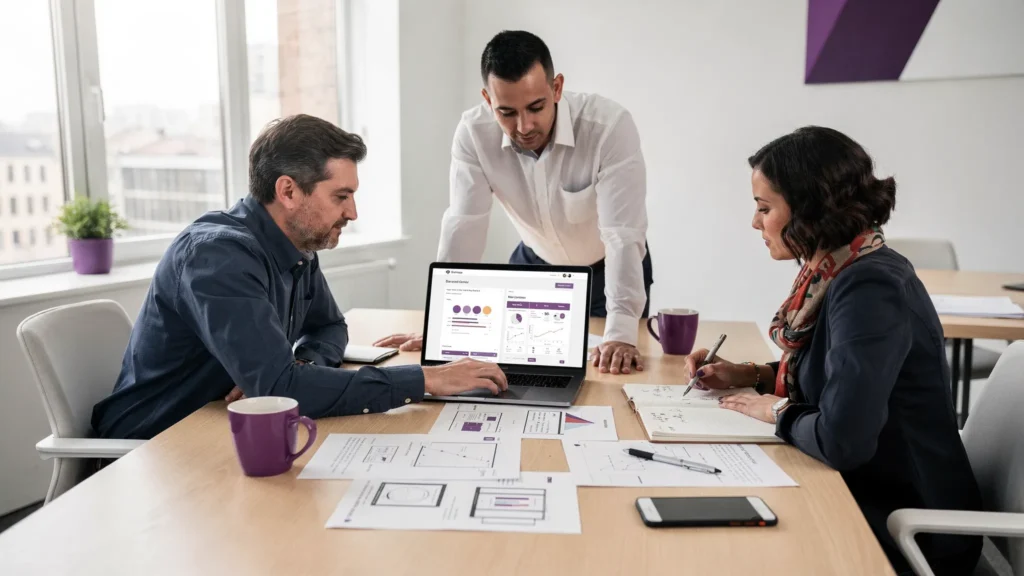
Most small businesses do not struggle because they lack “a website” or “marketing.” They struggle because those two efforts are owned by different people, measured differently, and updated on different timelines.
A website design and marketing company that works as one partner solves a very specific problem: it turns your site into the operating system for lead generation, sales follow-up, and measurable growth, not a brochure that looks nice and quietly underperforms.
This matters even more for local businesses in Los Angeles and the Inland Empire, where competition is dense, mobile traffic is dominant, and Google’s local results reward clarity, speed, and trust.
What the “one partner approach” actually means
When a single team owns both website delivery and marketing outcomes, a few things change immediately:
- One strategy, one backlog: the same roadmap governs copy, design, SEO, landing pages, and conversion improvements.
- One measurement standard: you are not stuck translating “design feedback” into “campaign KPIs.”
- Fewer handoffs: fewer broken forms, missing tracking tags, or “we thought they handled that” moments.
- Faster iteration: marketing insights turn into site improvements quickly, without vendor ping-pong.
A good way to think about it is simple: marketing creates demand, and the website captures and qualifies it. If those two are disconnected, you pay to drive traffic to a leaky bucket.
Why splitting web and marketing often breaks performance
Hiring separate specialists can work for larger teams with strong internal leadership. For most small businesses and non-technical founders, the split creates predictable failure points.
1) Trust and credibility are decided in seconds
Design is not just aesthetics. It is perceived legitimacy.
Stanford’s Web Credibility research is widely cited for showing that people judge an organization’s credibility based on its website design (often quoted around 75%). Even when a visitor arrives from a referral or an ad, the site still has to “close” the click into a call, form fill, or purchase. Source: Stanford Web Credibility Project.
2) Speed and mobile experience change your conversion rate
A slow site does not just feel annoying, it actively reduces results.
Google’s research highlights that 53% of mobile visits are abandoned if a page takes longer than 3 seconds to load. Source: Think with Google.
When marketing is outsourced and the site is built without performance standards, paid clicks cost more and local SEO suffers.
3) Tracking breaks at the seams
This is the most common operational problem we see:
- the marketing team launches campaigns
- the website team “finishes the site”
- nobody owns end-to-end conversion tracking
You end up with questions like:
- Which channel drives booked jobs, not just traffic?
- Are phone calls tracked?
- Are form fills mapped to a CRM?
- Is the Google Business Profile driving measurable leads?
If the website and marketing teams use different definitions of success, your reporting becomes noise.
Split vendors vs one partner, side-by-side
| Area | Split vendors (common outcome) | One partner approach (goal) |
|---|---|---|
| Strategy | Marketing plan and site plan drift apart | One shared positioning and conversion plan |
| SEO + development | SEO requests wait behind dev priorities | SEO requirements built into templates and page types |
| Analytics | Partial setup, unclear ownership | One tracking plan from day one (events, calls, forms) |
| Iteration speed | Changes queue across vendors | Faster updates and tighter feedback loops |
| Accountability | “Not our scope” issues | One owner for results, not just deliverables |
The integrated roadmap (what a good partner actually builds)
A website that performs is usually the result of a predictable system. Here is what the one partner approach looks like in practice.
Phase 1: Discovery that connects business goals to site structure
This is where a website design and marketing company earns its keep. The goal is not to collect opinions, it is to make decisions.
A strong discovery phase typically clarifies:
- Your core offers (and which ones actually make money)
- Your service area (and what “local” means for search)
- Your top conversion actions (call, quote request, booking, purchase)
- Your trust signals (licenses, warranties, reviews, before/after, case studies)
- Your sales process (how a lead becomes revenue)
When discovery is skipped, you often get a site that is visually polished but structurally vague, so marketing has to compensate with higher ad spend.
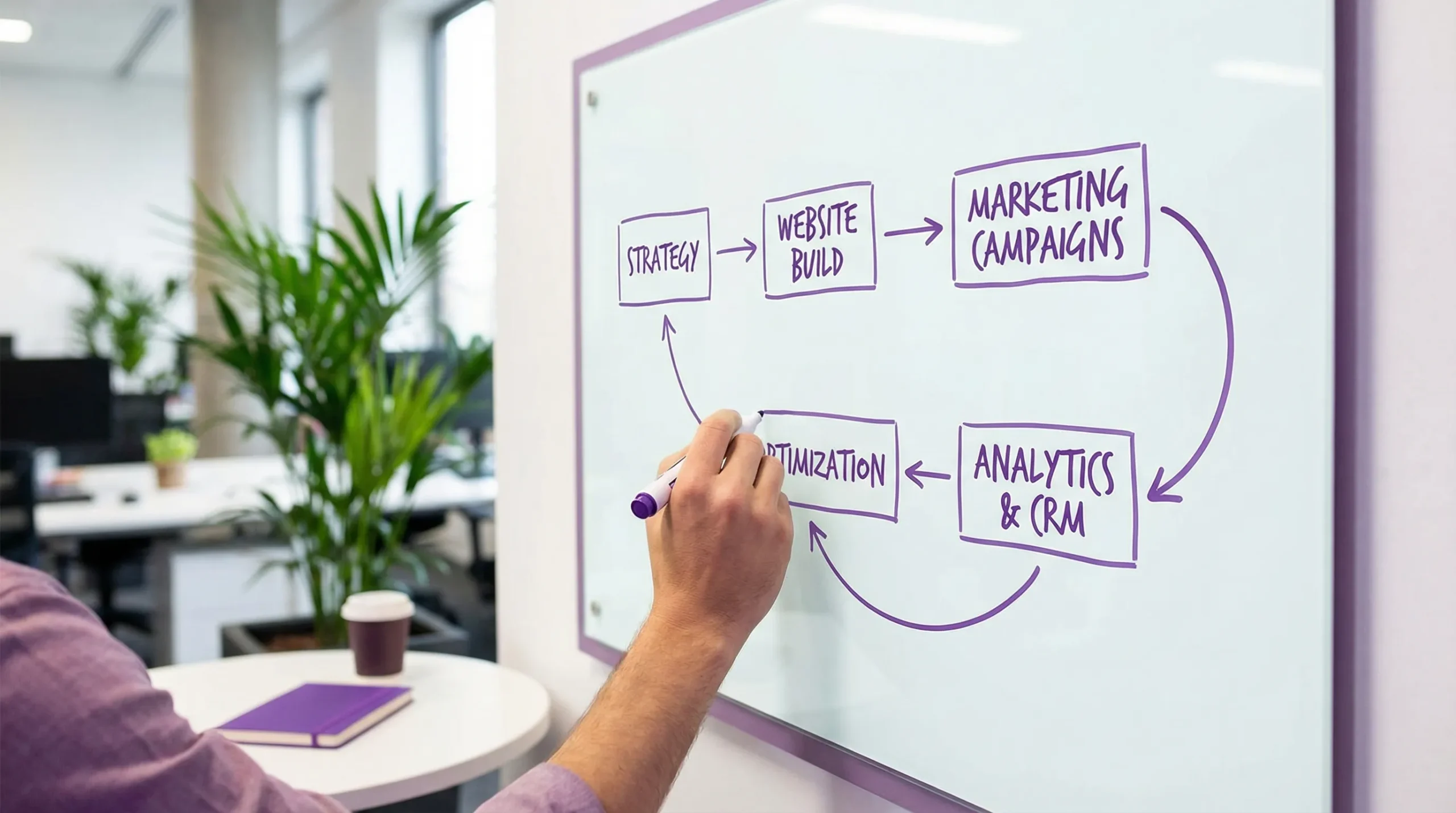
Phase 2: Conversion architecture (not just “pages”)
Most small business websites should be designed around a small set of page types that match intent:
- High-intent service pages (one per core service, localized where appropriate)
- About and trust pages that answer “why you?” without fluff
- Lead capture flows (quote forms, booking, click-to-call, SMS, chat if relevant)
- Proof assets (projects, testimonials, reviews, guarantees)
- Location signals (service areas, embedded map, consistent NAP)
This is where marketing and design overlap: the content needs to match what people search, and the page layout needs to make the next step obvious.
Phase 3: Technical build with performance, accessibility, and SEO foundations
A good build is less about the platform and more about standards.
Performance that supports both SEO and ads
Performance affects:
- local SEO visibility (especially on mobile)
- ad efficiency (lower waste, higher conversion rate)
- user trust (fast sites feel more legitimate)
This is also where technical choices (themes, plugins, third-party scripts, image handling) either protect or sabotage your marketing.
Accessibility and compliance (the often-missed growth lever)
Accessibility is not only about risk reduction, it is also about usability. Clear contrast, readable fonts, keyboard-friendly navigation, and proper form labels improve conversion.
If you need a reference standard, WCAG is the common benchmark. Source: W3C WCAG 2.2.
Phase 4: Launch with measurement you can trust
A high-quality launch is not “the site is live.” It is:
- analytics installed correctly (often GA4 plus Google Search Console)
- conversion events tested (forms, calls, booking, checkout)
- a clear baseline report (what we will improve from here)
This is where a one partner team prevents the classic problem of running ads to pages that do not track conversions properly.
Phase 5: Ongoing growth (where one partner really pays off)
Once the foundation is correct, marketing becomes less chaotic and more mechanical.
A practical ongoing loop looks like:
- review which pages generate leads (not just visits)
- improve the pages with high impressions but low clicks
- strengthen local relevance (service area content, FAQs inside pages, review strategy)
- run targeted campaigns to proven landing pages
- add automation so leads get responses quickly
For local businesses, this is also where the site can connect to your operations: routing leads by service, syncing form fills into your CRM, or triggering follow-ups.
What to ask when hiring a website design and marketing company (without getting lost in jargon)
You do not need to be technical to vet a partner, you just need to ask questions that reveal whether they own outcomes.
Here are the most telling areas:
Ask for deliverables, not promises
A serious partner can explain, in plain English, what you will receive. Examples of deliverables that typically indicate maturity:
- a sitemap or page plan tied to services and intent
- wireframes or layout direction for key pages
- copy guidance (or copywriting support) aligned to real searches and objections
- a tracking plan (what counts as a lead and how it is measured)
- launch QA (forms, call tracking, mobile testing, speed checks)
Ask how they handle “after launch”
A site that never changes usually declines.
Ask:
- What does ongoing support and maintenance include?
- How are SEO and local optimization handled over time?
- How do you prioritize improvements (data, not opinions)?
Ask who owns integration work
If your business depends on fast follow-up, integrations matter. Even simple connections can change results:
- forms to email and CRM
- missed-call workflows
- booking confirmations
- review requests
A one partner team should be comfortable discussing integrations and workflow automation in terms of business outcomes.
What “good” looks like in the real world
The one partner approach is easiest to see when you look at businesses with complex buyer questions.
For example, a manufactured home dealership has to present models, specs, floor plans, financing steps, and locations in a way that builds trust quickly and makes inquiry easy. A site like Homes2Go San Antonio’s manufactured homes inventory is a useful reference point for how product-driven, high-consideration businesses structure information to move visitors toward contacting the team.
The takeaway is not to copy another site, it is to recognize the pattern:
- clear navigation built around buyer intent
- proof and specifics (not vague claims)
- strong lead capture paths
- content that reduces sales friction
That same pattern applies whether you are a home service business in LA, an e-commerce brand, or a B2B startup founder trying to generate demos.
A 90-day scorecard that keeps design and marketing aligned
If you want your website and marketing to stay connected, choose a small set of metrics that map to revenue and operational reality.
| What to track | Example KPI | Why it matters | Common tool |
|---|---|---|---|
| Lead volume | Form submissions, calls, bookings | Measures demand captured, not just traffic | GA4, call tracking, CRM |
| Lead quality | Qualified leads, booked appointments | Prevents vanity growth | CRM pipeline |
| Local visibility | Impressions and clicks on service pages | Shows whether local SEO is gaining ground | Google Search Console |
| Conversion rate | Landing page conversion rate | Reveals whether pages match intent | GA4 |
| Speed/user experience | Core Web Vitals, mobile load time | Protects SEO and ad efficiency | PageSpeed Insights |
| Follow-up speed | Time to first response | Faster response usually increases close rate | CRM, inbox logs |
When one partner owns the loop, the “website work” and “marketing work” stop competing for attention and start feeding each other.
How Brother Web Design fits the one partner model
Brother Web Design’s positioning is naturally aligned with this approach because the team covers both sides of the system: custom web design and the growth stack that supports it (digital marketing, SEO and local optimization, lead generation, and integrations).
Depending on what your business needs, that can include:
- custom websites and e-commerce solutions
- app development and custom software
- workflow automation and CRM development
- ongoing support and maintenance
- integration with business tools
If you are a small business in Los Angeles or the Inland Empire, the practical advantage of working with a local, in-house team is collaboration speed: fewer handoffs, clearer communication, and faster iteration when something in the market changes.
If you are evaluating partners right now, the simplest next step is to request a plan that ties your website build to measurable marketing outcomes (leads, booked jobs, and revenue), not just a design concept.