
Most local business websites do not fail because the owner picked the “wrong colors.” They fail because they do not produce measurable business outcomes: phone calls, form fills, bookings, store visits, quotes, or online orders.
That’s why hiring a custom web design company is best evaluated through ROI, not aesthetics. A site that looks “fine” but leaks leads is a hidden monthly cost.
What “ROI” means for a local business website
ROI (return on investment) is simply: what you gained versus what you spent.
A practical version for a local business:
Website ROI = (additional profit created + costs reduced) − (website costs) / (website costs)
For most small businesses in Los Angeles and the Inland Empire, ROI usually shows up in three buckets:
- More qualified leads (calls, forms, bookings) from the same amount of traffic
- More local visibility (Google Business Profile and local organic) that increases traffic
- Less manual work (automations, better intake, fewer back-and-forths) that reduces operating costs
A custom website is not automatically “high ROI,” but custom is often what enables the specific changes that move these numbers.
Where ROI actually comes from (the 6 levers that matter)
A local website typically produces ROI by improving one or more of these levers. The job of a good custom build is to pick the right levers for your business model, then implement them cleanly.
1) Higher conversion rate (turn more visitors into leads)
If you are paying for ads, referrals are sending people to your site, or you show up in Google, your conversion rate is a direct revenue multiplier.
A conversion-focused custom design often improves:
- Clarity of the offer (what you do, who you do it for, why you)
- Location relevance (service areas, neighborhoods, proximity cues)
- Friction removal (shorter forms, click-to-call, streamlined booking)
- Trust (reviews, licensing, guarantees, before/after, case studies)
Even small conversion lifts can matter a lot. Example: going from 2% to 3% is a 50% increase in leads at the same traffic level.
2) Better local SEO performance (earn higher-intent traffic)
Local SEO ROI is not about “more traffic” in general, it is about more of the right traffic, such as people searching “emergency plumber near me,” “wedding florist El Monte,” or “CPA in Pasadena.”
Custom web design supports local SEO by making it easier to implement:
- Clean site architecture and internal linking
- Location and service pages that match real search intent
- Fast mobile performance (important for both rankings and conversions)
- Strong technical foundations (indexing, schema markup, crawlability)
Google’s own documentation emphasizes that site speed and user experience are part of building quality web experiences, and Core Web Vitals are a commonly used set of performance signals for measuring that experience (see web.dev Core Web Vitals).
3) Faster lead response (protect the leads you already earned)
For many local businesses, ROI is lost after the form fill. If your response time is slow, you can end up paying for leads you never close.
Custom builds often increase ROI by improving lead handling, for example:
- Instant confirmation texts/emails
- Routing leads to the right person (sales, scheduling, specific location)
- Capturing better details upfront so you can quote faster
If Instagram is part of your acquisition channel, you can also connect your website and CRM workflows with specialized automation. For example, tools like Orsay (AI Instagram lead generation) position themselves around fast inbound responses and automated follow-up, which can meaningfully impact booked appointments when your team is small.
4) Higher average order value (AOV) or deal size
E-commerce stores think about AOV constantly, but service businesses have the same lever.
Custom websites can increase deal size by:
- Packaging services into clear tiers (good, better, best)
- Adding upsells (maintenance plans, add-ons, expedited service)
- Using better qualification to reduce low-fit inquiries
This is one of the most overlooked ROI drivers because it does not require more traffic at all.
5) Lower operational cost (automation and fewer repetitive tasks)
ROI is not only “new revenue.” If your site reduces admin hours, it is producing real value.
Examples:
- Automated appointment booking that reduces phone tag
- Quote request forms that collect the info you always ask anyway
- CRM integration so leads are not copied and pasted manually
For non-technical founders, this is often the most satisfying kind of ROI because you feel it every day.
6) Reduced risk (security, compliance, and broken-site costs)
A site that is down, hacked, or collecting leads incorrectly can quietly destroy ROI.
A custom build done properly often includes stronger fundamentals like updates, backups, security best practices, and accessibility considerations. While this is harder to quantify, it prevents expensive problems.
A simple ROI model you can use in 10 minutes
You do not need fancy analytics to estimate ROI. You need a few numbers you can reasonably guess.
Here’s a quick model:
- Monthly site visitors (from Google Analytics or your current tool)
- Conversion rate (leads ÷ visitors)
- Close rate (new customers ÷ leads)
- Average profit per customer (not revenue)
Then estimate improvements that a custom web design company can realistically deliver.
Example (service business):
- Visitors: 1,500/month
- Conversion rate: 2% (30 leads)
- Close rate: 30% (9 customers)
- Profit per customer: $400
Current profit attributed to website: 9 × $400 = $3,600/month
If a rebuild improves conversion rate from 2% to 3%:
- Leads: 45/month
- Customers: 13.5/month (round to 13)
- Profit: 13 × $400 = $5,200/month
Estimated lift: +$1,600/month
If your all-in website investment (build + ongoing care) averages $500/month over a year, you can see how ROI becomes measurable.
What to track so ROI is real (not vibes)
If you want ROI, you need tracking that matches how local businesses actually sell. For most small teams, that means tracking these events end-to-end:
- Phone calls (tap-to-call on mobile, call tracking if you run ads)
- Form fills (with a clear “thank you” conversion)
- Bookings (if you use an appointment tool)
- Direction clicks (especially for storefronts)
And you need basic attribution:
- Source channel (organic, Google Business Profile, paid, social, referral)
- Landing page (which page produced the lead)
- Lead quality (which sources produce customers, not just leads)
A custom build is valuable when it is designed around capturing and routing these conversions cleanly, not just “installing analytics.”
ROI measurement table (what to improve, what to measure)
| ROI lever | Website change | Metric to watch | What “good” looks like |
|---|---|---|---|
| More leads from same traffic | Stronger messaging, better CTAs, fewer steps | Conversion rate (leads/visitors) | Steady increase over 30 to 90 days |
| More local traffic | Local landing pages, technical SEO, internal linking | Organic clicks + top queries | More impressions and clicks on high-intent searches |
| Better lead quality | Clear service areas, qualification forms | Close rate (customers/leads) | Close rate increases even if total leads stay flat |
| Faster response | Automations, CRM routing, instant confirmations | Time-to-first-response | Minutes, not hours |
| Bigger deals | Packaging, upsells, clearer pricing logic | Profit per customer | Higher profit without increasing ad spend |
| Less admin work | Booking, intake, integrations | Hours saved per week | Fewer manual follow-ups and less rework |
Timeline: when local businesses usually see ROI
ROI timelines depend on whether you already have traffic.
- If you run ads or have steady referrals: conversion improvements can show ROI within weeks of launch.
- If you rely on SEO: local SEO gains often take longer because Google needs time to recrawl, reevaluate, and because competition is real. Many businesses see meaningful movement in 2 to 4 months, then compounding gains after.
- If you add automation: operational ROI can be immediate, once your team uses the new process.
The biggest ROI delays are not “Google being slow.” They are usually content readiness (no photos, no reviews, unclear services), and slow follow-up once leads arrive.
What to ask a custom web design company if you care about ROI
If you are a non-technical founder, you do not need to ask about frameworks or libraries. Ask questions that force clarity about outcomes:
Ask about conversion strategy (not just design)
A serious team should be able to explain:
- What the primary conversion is (call, form, booking, order)
- How many clicks it takes to convert
- What proof elements will be used and where
Ask about local search intent
You want to hear specifics like:
- Which services should get their own pages
- Which locations/neighborhoods matter
- How they will prevent “thin content” location pages
Ask how leads flow into your process
ROI dies in the handoff. Ask:
- Where do form fills go?
- Do you get notifications?
- Can it connect to your CRM or email provider?
- What happens when you miss a call?
Ask about post-launch iteration
The first launch is rarely perfect. Ask what happens after:
- Do you review data and iterate?
- Do you A/B test key pages?
- Do you improve landing pages based on real queries?
If a vendor cannot describe a plan for measurement and iteration, you may be buying a one-time deliverable, not an ROI system.
Common ROI killers (even with a “nice” website)
Many local sites look clean and still underperform. These are frequent reasons:
Generic messaging above the fold. If your homepage could belong to any competitor in LA, it will convert like one.
No dedicated pages for high-value services. If every service is buried on one page, you make it harder for Google to rank you and harder for customers to self-qualify.
Weak trust signals. Local buyers want proof: reviews, licenses, guarantees, real photos, and examples.
Slow mobile experience. Mobile is where most local intent happens. A fast site is not “technical flex,” it is conversion insurance.
Leads not captured correctly. Broken forms, emails going to spam, no notifications, or no CRM routing can erase ROI.
Bringing it home: what “high ROI custom web design” looks like in practice
A high ROI website for a local business is usually not the most artistic website. It is the one that:
- Makes it obvious what you do and where you do it
- Turns mobile visitors into calls, bookings, or quote requests with minimal friction
- Proves trust quickly (reviews, credentials, real work)
- Supports local SEO with content that matches real searches
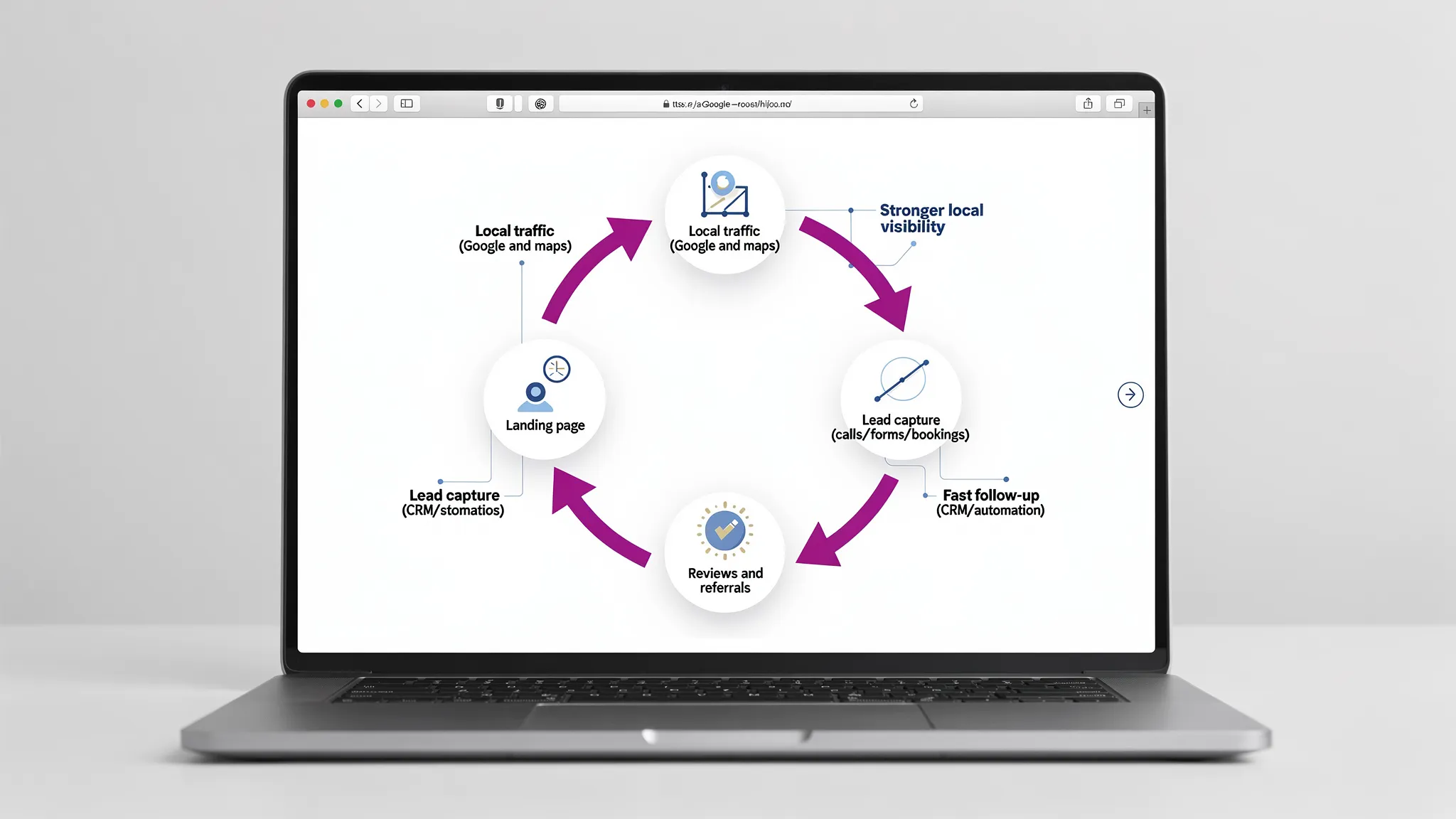
- Connects leads into a follow-up process so opportunities are not lost
Brother Web Design builds custom web design, development, and marketing systems for small businesses and startups across the LA and Inland Empire area, with an emphasis on collaboration, speed, and quality. If you want a website plan that is tied to measurable ROI, start by mapping your lead flow and the one or two levers that will move revenue the fastest.
If you want a deeper checklist of what should be included in a professional build, you can also review what to expect from modern web design services in 2025 on the Brother Web Design blog: Web Design Services: What Small Businesses Should Expect.